
We all pitch ideas. To teammates, managers, clients, or even friends. Sometimes it’s a formal presentation. Other times, it’s a quick chat by the coffee machine. Either way, we want the same thing 一 to be heard and understood.
The Secrets of Effective Pitch: How to Make People Listen (and Remember)
So how do you get your point across quickly and clearly in a world where everyone is busy and distracted? How do you make sure people get your idea, remember it, and want to hear more?
We had a big talk with Dmitry Smirnov, a public speaking coach and the mentor behind our Marathon for Speakers course.
We talked about elevator pitches, the common fears around public speaking, and how to get better at expressing ideas without sounding like you’ve just swallowed a PowerPoint presentation. Get ready for tips, stories, and a good dose of speaking wisdom.
“If you want people to hear your idea, make them feel the problem first.”
一 Dmitry, could you tell us a bit about yourself? What do you actually do, and how long have you been teaching?
一 My wife says I’m a professional chatterbox — and she’s not wrong. But officially, I’m a coach in public speaking and effective communication.
I’ve been working in this field for about 18 years now. It all started with journalism and radio, but over time, I moved into communication training. Today, I help people and teams present their ideas clearly, speak at conferences, and communicate better inside companies.
What is an elevator pitch?
The name comes from the early days of startups, when young entrepreneurs would try to pitch their projects to investors inside elevators. Elevators move fast, so they had to speak even faster. That’s how the concept was born. Inside a company, it’s more about convincing a teammate, a manager, or a group to consider your idea. Maybe you run into someone near the coffee machine, at the gym, or after a meeting. You’ve got just a moment to explain your thoughts and make them care.
%20(1).jpg?width=5070&height=3384&name=Owner%20(15)%20(1).jpg)
一 So, how to deliver your idea fast and clearly? Is there some universal structure of a good pitch?
一 There’s a classic pitch structure, which I often show during training sessions. It starts with the problem and solution.
It sounds basic. Too basic, maybe. But it’s also what most people forget.
When presenting something inside a company, people often skip the problem part. They start with, “Hey, I’ve got a cool idea for improving our reports.” But no one needs more ideas. Everyone’s already swimming in ideas.
Now compare that to: “I checked — we’re spending three hours a day on this reporting process.” Suddenly, I’m listening. It feels like it’s about me.
You’re not talking about your cool idea anymore. You’re talking about my pain. And now I want to hear the rest.
一 So the problem must come first, but what makes it convincing?
一 You need to draw a picture. People don’t think in words or numbers. They think in images. And your job is to help them see the problem.
Here’s a simple example I use at training sessions. I call it the "TV shopping trick." Imagine you’re trying to sell a cake knife.
In a typical pitch, people say: “This cake knife is a unique tool that improves dessert serving.” That’s boring.
But what happens in real TV shopping? They start with a black-and-white scene. A person is struggling with a cake. It’s falling apart. Their fingers are covered in cream. The slices are uneven. Kids are crying. Chaos.
Only then comes the pitch: “But now, there’s a better way…” This works because the problem feels real. It’s visual. It triggers emotion. And only then are people ready to hear the solution.
It’s the same with workplace ideas. Draw the ugly picture first. Let people feel the inconvenience. Only then offer the fix.
And for the solution, be just as clear. Don’t say, “It will be faster and more efficient.” Say what will actually happen. Where will they click? What will they see? How long will it take? What changes?
So when you pitch something, even if it’s just a change to a workflow, make it visual. Let people see the problem and imagine a better version.
.jpg?width=2500&height=1667&name=IMG_1192%20(1).jpg)
Alias 一 the best way to train your pitching muscle
一 What skills should someone develop to get better at pitching ideas and how?
一 A lot of people think it’s about using fancy words. But the opposite is true. The most important skill is learning how to create mental images with your words.
To train this skill, I suggest playing the game Alias. It’s simple: you get a word, like “crocodile,” and you have to describe it without naming it. And you have to do it fast. This helps you cut the fluff and focus on clarity and speed. I recommend it to everyone who wants to improve their communication.
You can also try this alone. Pick an object, like a paper cup. Then explain why someone needs it. Start with the pain — what’s inconvenient without it. Then describe how it helps. That’s already a mini pitch.
There’s one more trick I often use with students: turn on a cartoon, mute the sound, and try to voice it over in real time. Like a live sports commentator. It’s not easy, but it teaches you to think on your feet and speak clearly under pressure. That’s exactly what you need when presenting ideas.
一 What would you say to people who are afraid to speak up even in small meetings?
一 Start small. Don’t wait for a big moment. Just say one more sentence than you usually do.
If you’re out with friends, tell a short story. At work, add a comment during a call. When someone asks how your day was, don’t just say “fine” — give a little more. That’s how confidence builds. You speak, and you see that nothing bad happens. You didn’t mess up. You didn’t get laughed at. And next time, it gets easier.
When in a meeting, also pay attention to your body. Most people try to hide their nervousness by speaking quietly or shrinking into their chair. But that only makes it worse. Your voice disappears. You lose the room.
Instead, sit upright. Keep your feet grounded. Speak clearly, so that everyone can hear you — not just your mic. Even if you're on Zoom, imagine you're filling a real space with your voice.
It might sound simple, but posture and voice are everything. You fix those two, and the rest follows.
%20(1).jpg?width=4552&height=3035&name=Owner%20(20)%20(1).jpg)
一 Let’s settle an old debate. What matters more — content or charisma? We’ve all seen charismatic speakers who say a lot but not much of value.
一 That’s a classic question. I actually open most of my workshops with it.
There’s a popular statistic floating around online: 55% of our message is body language, 38% is voice, and only 7% is actual words. It sounds scientific; some even cite the author. But I’m picky. I always go to the source. And guess what? That study had nothing to do with public speaking. Totally unrelated.
If I’m speaking to a critical audience — which I hope most people are — then the content really matters. A speaker may start strong, capture attention, but after a minute, people begin to wonder: what’s the point?
On the other hand, if it’s a personal story, a “fail night” talk, or something emotional, then yes, energy and emotion play a bigger role. You’re not selling an idea — you’re sharing a human experience.
Still, my background is in journalism, so for me, content always comes first. Ideally, it’s a balance. One-third voice and presence, one-third delivery, one-third actual message. But if I had to pick one, I’d go with a message.
一 Have you ever heard a speech or pitch that inspired, confused, or made you laugh out loud?
一 Yes. There was one where the person opened with: “So, we’re offering a unique solution. It starts with a rabbit. And this rabbit has a friend, a fox.”
And I’m sitting there wondering, “What on earth is this? Is it a fairy tale?” They kept going, explaining the personalities of the rabbit and the fox. And only toward the end do we learn it’s an app… about ecology.
Now, I get it. They were excited. They cared about every detail. But they got lost in those details and completely forgot the main point.
But honestly, I rarely laugh at public speakers. I feel for them. Speaking in front of people is hard. There’s that famous line: public speaking is the second most common fear after death, and it’s true.
So even if someone rambles about cartoon animals, I respect the courage it takes to stand up and speak.
一 And final question: If you could give one simple piece of advice about communication, what would it be?
一 Keep it simple. The main thing is to say your idea clearly and in as few words as possible. Don’t try to sound smart or use too many fancy words. Focus on one idea at a time. This makes it easier for people to understand you.
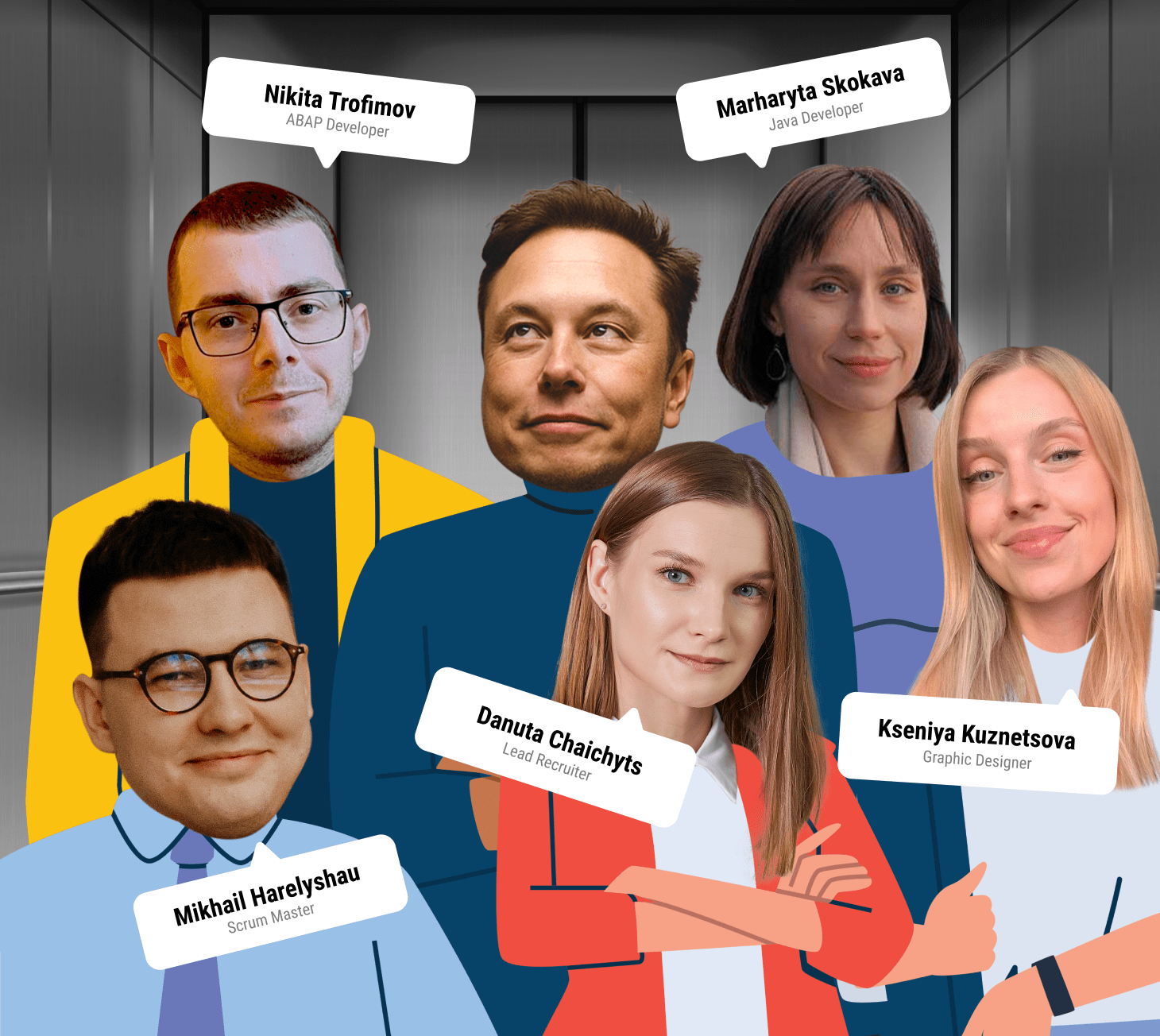
Many #leverxpeople improved their public speaking skills under Dmitry’s guidance
However, how would they do an elevator pitch to… Elon Musk?
Mikhail Harelyshau, Scrum Master
Elon, I’m working on an app that transforms the cooking process into a SpaceX-like system. We’ll have less waste, more optimized processes, and precise planning. This will save us millions of tons of food in space. Let me tell you how it works.
Marharyta Skokava, Java Developer
Have you got a cat? I’ve got two, and, apparently, there are no good automatic cat litter boxes on the market. We could build such a device (and I know how to do it), but the key is to create a community of cat owners. Cats are shy and conservative, so they need to be taught to use the device. I had to hold my cat’s paw for her to feel comfortable enough for the first time. We can solve this problem for cat owners everywhere, starting with the ones who, like me, love their cats but hate the litter box. Are you in?
Nikita Trofimov, ABAP Developer
Elon, SpaceX is tackling the problem of space waste, while Neuralink is testing human implants. What if we combined both efforts and turned them into public entertainment? Have you ever seen Spy Kids? One of the movies featured a robot combat scene, and we could actually replicate that. Imagine building robots from recycled SpaceX materials and having Neuralink users control them. Beyond recycling, the battles could become a hit TV show and a way to test Neuralink technology. What do you think?
Danuta Chaichyts, Lead Recruiter
Elon, are you using SAP for Tesla’s internal processes already? If not, we are coming to you!
Kseniya Kuznetsova, Graphic Designer
Elon, if you met your 35-year-old self in an elevator, what would you ask?


-1.png)