In this article, LeverX's Senior Business Analysts Anna Gurinovich and Volha Tabolina explain where AI in business analysis delivers the most value, where it still falls short, and which prompts and best practices make the biggest difference.
AI in Business Analysis: Best Practices for 42% Time Savings
AI is already part of daily business analysis work, but few actually measure its impact. At LeverX, we did. Across our Business Analysis team, routine task time dropped by 42% after structured AI adoption. However, that number doesn’t apply to all BA work.
Key Takeaways
- Around 40% of a typical BA workload can be optimized with AI tools.
- Routine documentation and research benefit most; strategic planning sees minimal automation impact.
- AI delivers strong first drafts, but final accountability remains with the BA.
- Free AI tools must never process confidential project data due to security risks.
AI Productivity Research: Time Savings Statistics
Business analysts rarely work in ideal conditions. Whether you are working with enterprise clients or smaller teams, the pattern is the same: there is never enough time to go with analysis as deep as you would like.
Partly because BA work is documentation-heavy by nature, you have less time to explore options, challenge assumptions, and refine the solution before development begins. But this is where AI starts to make a difference.
We decided to measure that impact. In 2025, LeverX tracked how much time AI saved across various tasks in 12 teams representing QA, Development, UI/UX, Business Analysis, and other departments. In total, around 70 colleagues (approximately 3% of the company’s workforce) participated in the focus group. From the Business Analysis department, six specialists took part, using tools such as Gemini and ChatGPT.

Our findings showed that around 40% of a typical BA’s overall workload could be optimized by AI. However, this optimization was distributed between “routine” vs. “strategic” effort.
As Anna Gurinovich explains:
“Routine, standardized activities saw the biggest boosts, 42% mark in time saved, whereas the most strategic activities saw little to no direct improvement.”
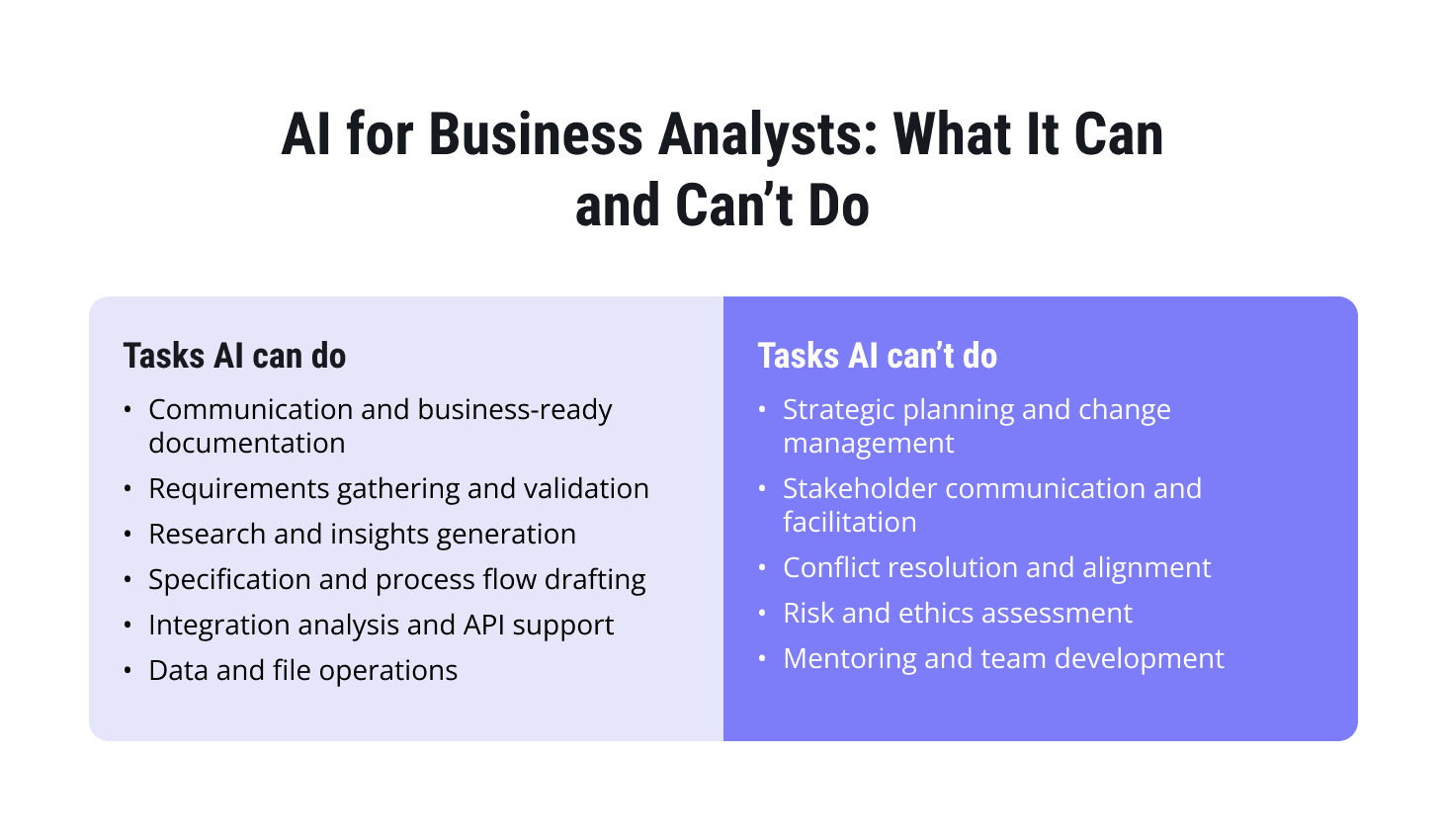
AI can support a surprisingly wide range of BA activities. But even in the strongest AI use cases in business analysis, a BA remains in control, reviewing, adjusting, and validating every output.
At the same time, in areas where work is deeply human (like conflict resolution or stakeholder alignment), AI still has value as a support tool, for example, summarizing a conflict’s history or suggesting a risk checklist.
With these conditions in mind, let’s move from theory to practice.
How Do Business Analysts Use AI
Our research identified about 15-20 task categories where AI delivers a significant impact.
| Task Category | What AI does |
| Communication |
|
| Requirements |
|
| Research |
|
| Process Flow |
|
| Integration Analysis API support |
|
| Data |
|
Given this breadth of application, AI can be effectively integrated across the entire business analysis lifecycle: from initial discovery through delivery and validation.
The most immediate value is observed at the early stages, during pre-sales and initial research.
How to Use AI for Pre-sales Research
During this stage, analysts typically assess the client’s business context, objectives, market position, and delivery constraints. What we found, however, was that the sales function needed structured insight even earlier, during the first client conversation.
To address that, our BA team designed a standard research template and process covering company background, competitive positioning, and solution context. The purpose was straightforward: equip sales representatives with decision-useful information before the first call.
Case study: AI for competitive analysis
One of our early wins with AI came in supporting our sales team with quick, in-depth client research. To make it scalable, the team did two things:
- Built a reusable research template
- Defined trusted data sources and prepared structured prompts
Every iteration revolved around one question: What does a sales representative need to know before the first conversation? The result was a 20-page structured brief covering core sections:
- Client products and offerings
- Value propositions
- Potential RFPs
- Target audience
- Competitors and partners
- Digital transformation vendors
- Technical environment, including frontend and backend technologies
AI tools for business analysis: ChatGPT vs. Gemini vs. Custom AI Agent
In this case, the research was primarily powered by the “Deep Research” functionality in ChatGPT and Gemini (both tools were tested). We also attempted to replicate the process using a custom-built AI agent with the same prompts and requirements.
However, Deep Research produced significantly better, more comprehensive results for this type of task. The agent still provided useful high-level analysis, but it did not match the depth and structure achieved by Deep Research.
Still, BAs review and verify every output; AI isn’t infallible and can include outdated or slightly off-base information.
Another area we applied AI to was in accelerating the creation of Vision and Scope documents.
Case study: AI for Vision and Scope documents
This is one of the most effective AI use cases in business analysis. Vision and Scope documentation is typically produced under tight timelines. Teams need enough clarity to move forward, yet there is rarely time to develop a fully structured document from scratch. At the same time, these deliverables must still meet established BA standards and align with frameworks such as BABOK and Wiegers'.
This is where AI begins to create measurable value. We introduced a dedicated prompt framework designed to:
- Reflect BABOK and Wiegers' principles
- Enforce document structure
- Align with internal quality standards
As a result, in around 80% of cases, outputs required only minor edits. We reduced preparation time significantly while maintaining methodological rigor. This reflects a broader shift in business analysis using AI: less time spent on drafting and formatting, and more focus on requirements quality and decision-making.
However, this shift does not happen automatically.
How BAs Use AI in Requirements Management
In practice, the impact of AI in business analysis depends less on the tool itself and more on how it is integrated into the requirements management process. When used in isolation, AI provides limited efficiency gains.
At the same time, it is important to recognize that AI does not fix weak processes; it scales structured ones. This means that simply introducing AI is not enough. For it to be effective, BAs should apply scalable requirements principles that ensure consistency, reuse, and traceability across artifacts.
To make this more tangible, it is useful to look at how these principles translate into day-to-day practice when AI tools are integrated into the BA workflow:
|
Scalable Requirement Principle |
Original BA Responsibilities |
AI-Reinforced Responsibilities |
|
Focus on Intent, Not the Implementation |
|
BA: Defines clear, measurable business intent. AI: Structures it into testable requirements and highlights ambiguity. |
|
Build a Modular, Reusable Knowledge Base |
|
BA: Designs and governs reusable structure. AI: Detects overlaps and suggests modular optimization across documentation. |
|
Cultivate Living, Traceable Documentation |
|
BA: Evaluates impact and validates logical consistency. AI: Surfaces affected artifacts and supports impact analysis across tools. |
|
Implement Governance & Standards |
|
BA: Defines and maintains AI usage rules and quality standards. AI: Validates alignment with templates and flags non-compliant content. |
Each of these principles becomes meaningful only when translated into concrete working practices. Let’s break them down.
Focus on intent, not the implementation
At its core, strong business analysis starts with clarity of intent. AI can support this, but only when the input is clear and precise.
To ensure AI produces meaningful, business-aligned requirements:
- Always provide clear context: business goal, user role, constraints, and expected outcome.
- Use domain-specific terminology aligned with the project glossary to avoid generic outputs.
- Explicitly distinguish between business intent and technical implementation in the input.
- Treat AI as a reviewer, not a decision-maker.
- Validate that the final wording reflects intent rather than the convenience of phrasing.
Build a modular, reusable knowledge base
AI can support modularity, but it cannot create structure where none exists. The system itself must be designed and maintained by the BA.
Once that foundation is in place, AI becomes effective in identifying reuse opportunities and reducing duplication:
-
Maintain a single source of truth for each module; AI should always reference it.
-
Clearly reference related modules when introducing new requirements.
-
Review AI’s suggested links, validate context, and avoid false matches.
-
Keep documentation architecture intentional; AI supports structure, it does not define it.
Sustain living documentation
In complex systems, documentation evolves continuously. AI can assist with this, but only if artifacts are properly connected.
To maintain this “living” documentation:
- Integrate AI with Confluence and Jira APIs for real-time syncing, if that is applicable for your project management systems.
- Maintain consistent linking across all artifacts. AI can only track what’s connected.
- Automate change detection: Set AI triggers in Jira or Confluence to scan related requirements whenever epics, APIs, or business rules change.
- Ensure unique and stable identifiers are used across artifacts.
- Validate AI-suggested impact areas before implementing changes.
- Treat AI as a support mechanism for analysis, not as an automatic change executor.
AI can surface dependencies, but traceability integrity must be maintained by design.
Ensure governance and quality standards
AI strengthens governance only when standards are clearly defined and consistently applied.
To make this effective:
- Maintain centralized, clearly documented BA standards and templates.
- Keep acceptance criteria formats consistent and measurable.
- Periodically refine validation rules as documentation practices evolve.
- Ensure AI has access to the latest approved standards only.
- Retain accountability for final approval and risk assessment.
Every organization defines quality differently. AI can help enforce those standards, but only after they are clearly established. To understand how AI performs beyond isolated use cases, it is useful to look at how it operates within a complex, real-world delivery environment.
Case study: AI incorporated into requirements management workflow
In one case, a platform has been evolving for nearly a decade. The system had grown into something dense and interdependent: multiple integrations with payment providers and marketplaces, a large active user base, and five major modules tied closely enough that a change in one could ripple through the rest.
Against this backdrop, the documentation ecosystem had been built on solid foundations: scalable requirement principles, structured templates, and established BA best practices. However, as the system expanded, maintaining documentation integrity across modules became progressively more complex. Over time, manual effort alone was no longer sufficient to keep documentation synchronized with the system’s evolution.
In such an environment, isolated AI prompts are not sufficient. A single prompt cannot realistically capture years of dependencies and architectural decisions. Without contextual access, AI support in requirements elicitation and refinement becomes fragmented.
To make AI effective, it must operate within the documentation ecosystem rather than outside it.
On Volha Tabolina’s project, this was achieved by integrating AI with Atlassian tools (Confluence and Jira) via Rovo, connected to ChatGPT Enterprise. Similar enterprise integrations or secure knowledge connectors can provide contextual access to internal documentation while preserving governance controls.
As a result, AI was no longer working with isolated inputs. It became part of a structured system, with access to:
- Confluence and Jira (with controlled permissions)
- Department-approved templates and documentation standards
- Established scalable requirement principles
- Best practices aligned with BABOK and Wiegers'
This integration fundamentally changed how AI contributed to the BA workflow. Its effectiveness depends on:
- The level of documentation structure
- The clarity of standards and templates
- Terminology consistency
- Accessible historical context
In other words, the stronger the foundation, the more reliable and useful the AI support.
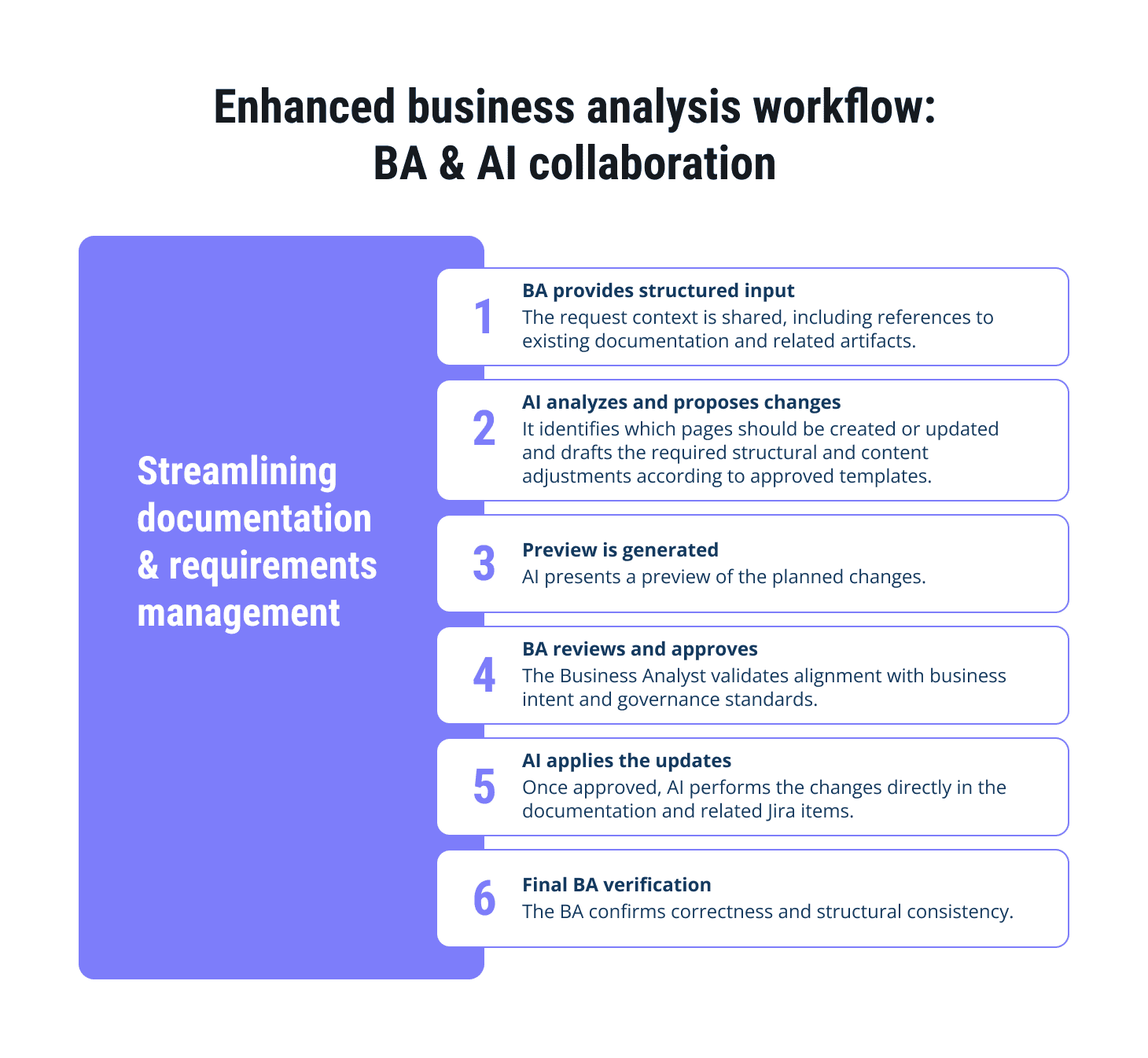
AI could review existing artifacts, identify gaps or inconsistencies, and either suggest or execute updates where permissions are allowed. This shifts its role from a support tool to a more embedded execution layer.
That said, accountability does not change. The Business Analyst still owns the outcome: reviewing, validating, and making final decisions. The main benefit is speed.
Limitations
While this approach is effective, it introduces a set of practical constraints that need to be managed.
- You'll need an enterprise or paid subscription, as secure integrations and governance controls are essential.
- Integration stability may occasionally cause temporary permission loss.
- Changing previews before publishing can be technical and difficult to interpret.
- AI-generated updates must always be reviewed and validated.
In short, AI reduces operational effort, but governance still needs to be actively managed.
Understanding how to use AI in business analysis also requires understanding where it should not be relied upon.
What BA Tasks Can’t Be Done by AI
Through LeverX’s internal focus group research, we identified a set of tasks that remain inherently human and can’t be delegated to AI, at least not with today’s technology.
As Anna Gurinovich notes:
“Many aspects of BA work require human thinking beyond data analysis. It also involves working with the emotional spectrum and managing communication dynamics. I don’t think AI will be able to do this anytime soon.”
| Task category | Why it's human | What a BA does |
|
Strategic planning & change management |
It requires long-term thinking and ongoing judgment. |
|
|
Stakeholder communication & facilitation |
It requires empathy and active listening, building trust with a client. |
|
|
Conflict resolution & alignment |
It requires empathy and active listening, as well as building trust with a client. |
|
|
Risk & ethics assessment |
It demands responsibility, context awareness, and human judgment. |
|
|
Mentoring & team development |
It involves experience, leadership, and soft skills that AI lacks. |
|
Strategic planning and change management
Before a plan takes shape, a BA evaluates what is technically and organizationally possible, and what might shift tomorrow.
For example, when planning a product roadmap or even a sprint, you might ask: What if the client’s priorities change next quarter? How will regulatory updates or new market information affect our direction?
These are not pattern-matching exercises. They require foresight, trade-off analysis, and a nuanced understanding of the business context. AI can support scenario modeling, but it cannot make the judgment behind the final call.
Stakeholder communication and facilitation
Interviews, discovery sessions, and retrospectives leave no room for rewrites. In those moments, your job as a BA is simple and demanding at once: ask clear questions, listen closely, and notice when people drift out of alignment.
This work depends on empathy and attention. BAs still read tone (not just words), spot a risk buried in casual remarks, and build trust by staying present.
Preparation follows a similar logic.
You still create the meeting agenda yourself, deciding what matters and what can wait. AI may suggest structure, but intent comes from you. After the meeting, AI earns its place.
Conflict resolution and alignment
Sooner or later, conflict shows up. Two teams hear the same requirement and walk away with different meanings. A client sounds calm, but the questions grow sharper. You feel the shift before anyone names it. This is part of the BA’s job.
Escalations make this even clearer. When a client is dissatisfied, your email response carries double weight. To write an answer correctly, you need to take into account all the prehistory: what happened, when it happened, and why expectations drifted. These messages often include sensitive context, and one careless sentence can deepen the problem.
The same applies to backlog work. When a request comes from a client, you need to capture it clearly and write it down so you can work with it later. At this stage, you can involve AI tools to support the process.
But this information still has to be collected manually at the start; you add the initial context yourself. The quality of that input matters. When you return to the backlog a month later and see only a few vague lines, you no longer remember the full context of what the client actually wanted.
Risk & ethics assessment
Risks take many forms. In practice, you usually recognize them before any tool does. You see repeated bugs, hear the same concern from different stakeholders, or notice hesitation during reviews.
Once you identify specific issues, you typically document them as a risk list. At that stage, AI becomes useful. You can ask it to analyze known risks, suggest related ones, or help you structure mitigation options.
However, AI does not surface the first signal. That insight comes from you through direct involvement in the project.
Mentoring
Junior business analysts often ask questions, but they struggle to phrase them in a way that leads to a useful result. They write something that looks reasonable, yet they cannot tell whether it actually works or simply sounds right. That judgment only comes with experience.
Volha Tabolina shares:
“Sure, AI can review text, but mentoring teaches judgment, and that lesson still passes best from one person to another. Earlier in my career, I attended meetings with senior Business Analysts, and I watched how they discussed tasks with clients and shaped their questions.”
Last but not least, you should be very mindful of data security and confidentiality.
Free AI Tools for Business Analysts: Security and Responsibility
As BAs, we often handle sensitive project information like requirements for proprietary systems and customer data. Our company policy strictly forbids using free AI tools or personal licenses to process project information or confidential company data.
However, publicly available information (for example, content you can find via Google) may be used in free versions.

Conclusion
In practice, AI in business analysis is not changing what a business analyst is responsible for. It is changing how that work is performed and where time is invested.
With less time spent on manual documentation work, business analysts can redirect their focus toward higher-value activities: understanding client goals in greater depth, validating assumptions earlier, analyzing business processes more thoroughly, and exploring solution options more deliberately. Stakeholder alignment also becomes stronger, as there is more time to clarify expectations before development begins.
AI allows BAs to consistently apply best practices and invest more effort in the discovery stage of the project, where most risks are still preventable. With increased analytical capacity, you reduce rework, limit scope drift, and prevent issues that would otherwise surface late in delivery. Most importantly, we can help clients define clearer and more realistic goals, ensure alignment between expectations and delivery, and build solutions based on a deeper understanding of actual business needs.